Cloth before design
A drawing is only useful once the cloth is decided, because silk faille and silk georgette will not hold the same line. Cuttings go out with every drawing for that reason.
A small made-to-order house, working the same way it did in 2009.
SEVRAINE was set up in a first-floor room off Chiltern Street in 2009 with one cutting table and a borrowed stand. The intention then was narrow and has not widened: gowns cut to order, in cloth chosen by the wearer, finished by hand, and not many of them in a year.
Nine people work in the atelier. Four are cutters and machinists, two work only on hand finishing and embroidery, two run the fitting rooms and one manages cloth and scheduling. There is no design director and no seasonal calendar imposed from outside; the collection changes when the workroom has something worth adding, which has been roughly every eighteen months.
We take about seventy commissions a year across both rooms. That number is set by the workroom rather than by demand, and it is the reason a bespoke commission needs nine months rather than four. When the diary is full we say so at the first enquiry instead of compressing the fitting sequence, because the fittings are where the gown is actually made.
A drawing is only useful once the cloth is decided, because silk faille and silk georgette will not hold the same line. Cuttings go out with every drawing for that reason.
Every bespoke commission is made in calico first. It adds three weeks and it removes the possibility of discovering a problem in a cloth that costs £180 a metre.
Three for a collection gown, five for a commission. A gown that has been fitted twice is a gown that fits twice as well as it should, and it shows in photographs.
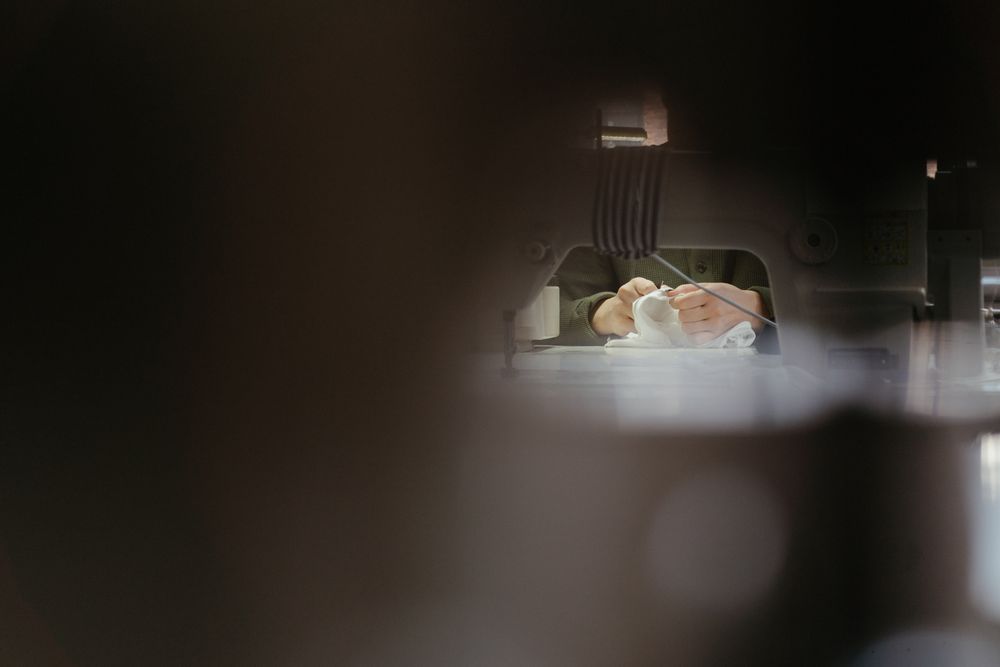
Nothing is sent to an outside workroom. The person who cut the gown is the person who alters it, which matters when a seam has to be opened and closed without a trace.
Silks come from two mills, one in Como and one in Suzhou, both of which we have bought from since 2012. Corded lace is bought from a house in Calais that still runs Leavers machines. Beads and glass are sourced in Paris. Lead times run from five to seven weeks and lengthen in August, when the Italian mills close; commissions placed in June are planned around that closure rather than around the wedding date.
Off-cuts above half a metre are kept and used for the covered buttons, sashes and travel bags that go out with each gown. What is left goes to two textile courses in London and Glasgow at the end of each season.